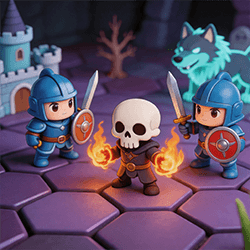
Monster Checkers
Description
Monster Checkers About This Game Monster Checkers is a casual piece placement and board battle strategy game where the most important decisions happen before the fight begins. Instead of rushing into battle, you need to read the board, understand the enemy layout, and place your pieces in positions that can hold pressure, cover routes, and support each other. The core gameplay is simple to understand: place your character pieces, start the battle, watch how both sides collide, and adjust your formation if the result does not work. The depth comes from the map. A narrow choke point rewards tighter route control, while a wide open board requires broader coverage. A divided map may force you to protect two pressure zones at once. This Monster Checkers guide focuses on beginner placement logic: where to place early-contact pieces, how to protect support-style pieces, how to avoid leaving side routes open, and how to improve after losing a battle. Treat each level like a small tactical puzzle. The question is not “Which piece looks strongest?” but “Where does this piece help the formation most?” How to Play Do not place pieces immediately when a level begins. First, look at the whole board. The closest enemy is not always the biggest threat; a side group, a center cluster, or an open lane can become the real reason your formation fails. A practical beginner flow looks like this: 1. Scan the enemy layout. Look for enemy clusters, side groups, and routes that lead toward your pieces. 2. Find the first contact point. This is where your formation is most likely to meet pressure first. On narrow maps, it may be a tight route or choke point. On open maps, it may be the side with the largest enemy group. 3. Place your front anchor. Use a piece that appears better suited for early contact near the first contact point. 4. Protect your safer support position. Support-style or less durable pieces should usually stay slightly behind or diagonally behind the front anchor when the board allows it. 5. Check the side route. Before starting the battle, look for any lane that is completely uncovered. Even a small enemy group can punish an empty side. 6. Keep pieces close enough to help. Your key pieces should be close enough to support each other. If they are too far apart, they may fight as separate weak groups. 7. Start the battle and watch the first clash. The opening moments show whether your front anchor holds, whether support pieces are exposed, and whether enemies are slipping around the side. 8. Change one major thing after a loss. Do not rebuild everything at once. Move the front anchor, protect the support piece, cover the side route, or tighten spacing, then test again. Beginner Strategy Guide The best beginner habit in Monster Checkers is to place with intention. Every piece should have a job: hold the first contact point, support the early-contact piece, cover a side route, or prevent the formation from splitting. The Bottleneck Defense Use The Bottleneck Defense on narrow route maps, especially when the enemy must pass through a tight choke point. Place your front anchor close to the first contact point. Then place support-style pieces slightly behind it or to the side. This creates a simple layered formation: the front piece handles the first pressure, while the support pieces stay safer and contribute from a better position. Do not stack every piece directly on the choke point. If your entire formation is packed into one small area, you may lose flexibility and leave nearby routes uncovered. A better Bottleneck Defense holds the narrow path while keeping at least one piece ready to cover a side opening. The Checkerboard Spread Use The Checkerboard Spread on open maps where enemies can approach from more than one direction. Instead of putting every piece in one corner, spread your pieces across the important lanes while keeping them close enough to support each other. Think of the board like a loose checkerboard: not every space needs a piece, but the important spaces should not be empty. A strong open-map setup usually covers the main enemy direction first, then places one piece toward a side route. Keep your support pieces protected, but do not place them so far away that they stop helping the fight. The Split-Lane Balance Use The Split-Lane Balance on divided maps where enemies are separated into two groups or the board has two pressure zones. Start by deciding which side is more dangerous. The side with the larger enemy group or faster first contact should receive more attention. However, the weaker side should not be completely abandoned. One isolated piece usually cannot hold an entire route alone, so keep it close enough to reconnect with the main formation. If the same side keeps collapsing, do not simply add more pieces to the strongest area. Move one piece toward the broken lane and shorten the distance between groups. Simple Formation Examples These are starting templates, not fixed winning formations. Adjust them after each failed attempt instead of copying them exactly. Balanced Beginner Formation Place one front anchor near the main contact point, one support-style piece behind or diagonally behind it, and one piece watching the side route. This is the safest beginner setup when you are still learning the map. Route Control Formation Use this on narrow maps. Put your front anchor near the choke point, keep support slightly behind it, and avoid overcrowding the entrance. The goal is to slow the enemy at the route instead of letting pressure reach your safer support position too quickly. Wide Coverage Formation Use this on open maps. Cover the main enemy direction, then place one piece toward a side lane. Your pieces should be spread out enough to cover space, but still close enough to help each other. Specific Enemy Layout Examples Enemies grouped near the center lane: Place a front-position piece near the first contact point in the center, then keep support close behind it. Do not send every piece to the exact same small area; leave enough spacing to prevent side pressure. Enemies split into left and right groups: Send more strength toward the larger group, but keep at least one piece or coverage point near the smaller group. If you ignore one side completely, the formation can get pulled apart. A small enemy group appears on the side: Do not dismiss it just because it looks less dangerous. Side enemies often cause losses by reaching unprotected support pieces. Place one piece toward that lane or widen your main formation. One of your pieces falls first every attempt: That piece is probably too exposed. Move it slightly back, place it diagonally behind a front anchor, or shift the first contact point away from it. Beginner Formation Checklist Before you start the battle, check these points: • Did I find the main enemy cluster? • Did I identify the first contact point? • Is my front anchor placed near the correct route? • Are support pieces protected from immediate contact? • Is one side lane completely open? • Are my key pieces close enough to support each other? • Does every piece have a clear job? After-Battle Review Frontline melted immediately Likely problem: your front anchor was too isolated, placed too far from support, or not positioned at the real first contact point. Better adjustment: move support closer, or shift the front piece toward the route where pressure actually begins. Flanked by side-route enemies Likely problem: one side lane was left open. Better adjustment: move one piece toward the side route or widen your formation before starting again. Support piece died instantly Likely problem: it was placed in the first contact position. Better adjustment: move it behind or diagonally behind a front-position piece. Pieces fought separately and lost one by one Likely problem: your formation was spread too far apart. Better adjustment: reduce the gap between key pieces so they can support each other. Formation got crushed in one crowded spot Likely problem: too many pieces were stacked into the same area. Better adjustment: keep the main route covered, but spread one piece toward a nearby lane. Small side group caused the loss Likely problem: you only looked at the largest enemy cluster. Better adjustment: scan the whole board before placing the first piece and assign coverage to side pressure. Change one major issue at a time. If you move every piece after every loss, it becomes difficult to understand which adjustment actually improved the formation. Common Mistakes Placing pieces before reading the map: Rushing placement makes it easy to miss side pressure, choke points, or the real first contact area. Choosing only the strongest-looking pieces: A strong piece still needs the right role. Front anchors, support positions, side coverage, and spacing all matter. Stacking every piece in one corner: This can make your formation look powerful while leaving the rest of the board open. Using the same setup on every map: The Bottleneck Defense may work on narrow maps, but open maps often need The Checkerboard Spread or wider side coverage. Repeating the same failed setup: If the frontline melts, support dies, or side enemies flank you, something specific needs to change. Placing support pieces in the first contact position: Support-style or less durable pieces should usually stay behind or beside the front anchor, not directly in front. Leaving one side route completely open: Even a small side group can break your formation if it reaches a safer support position for free. Spreading pieces too far apart: Wide coverage helps, but isolated pieces often lose before the rest of the formation can assist. Depending too much on one character piece: Do not expect one piece to hold two lanes, protect support pieces, and handle the main enemy group alone. Ignoring small enemy groups on the side of the map: Side enemies are easy to overlook, but they often explain why a formation that looked strong still failed. FAQ What is Monster Checkers? Monster Checkers is a casual piece placement and board battle strategy game where players arrange character pieces before battle and try to defeat opposing pieces on the map. How do you play Monster Checkers? You scan the enemy layout, find the first contact point, place your pieces with a clear role, start the battle, and adjust your formation after failed attempts. Why do my support pieces die instantly at the start of the battle? They are probably too close to the first contact point. Move them slightly behind or diagonally behind a front-position piece. Why does my frontline collapse so quickly? Your front piece may be isolated or placed too far from support. Bring nearby pieces closer so the front line is not fighting alone. What should I do if enemies keep coming around the side? You are leaving a side route open. Move one piece toward that lane or use a wider formation before starting the battle. How should beginners place their pieces in Monster Checkers? Start with one front anchor near the first contact point, protect support pieces behind it, and keep one piece or coverage point ready for side pressure. Do different maps require different strategies? Yes. Narrow maps favor route control, open maps need wider spacing, and divided maps require balanced pressure between lanes. What should I change after losing a battle? Change the first visible failure. If support dies, move it back. If the side lane breaks, widen coverage. If pieces fight alone, tighten the formation. Editorial Note This guide focuses on beginner placement logic for Monster Checkers, including board reading, first contact points, formation spacing, side-route coverage, and after-battle adjustment. Formation names such as Bottleneck Defense, Checkerboard Spread, and Split-Lane Balance are guide labels used to explain placement ideas, not confirmed official in-game terms. This guide does not present unconfirmed character stats, fixed skills, upgrade systems, reward rules, or full level data as facts. Pieces, characters, maps, battles, and rewards are discussed as virtual Monster Checkers game mechanics.