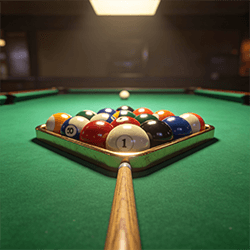
Cue Shot Challenge 3D
Description
Cue Shot Challenge 3D About This Game Cue Shot Challenge 3D is a casual 3D pool and billiards challenge game where your goal is to pocket all the balls before your lives run out. Each shot costs 1 life, so the main challenge is not speed, but choosing safer angles, controlling power, and keeping the cue ball in a useful position. The 3D view helps you judge ball spacing, pocket lines, cut angles, cue direction, and possible shot paths before taking a shot. This matters because one careless attempt can waste a life and leave the next angle blocked. Cue Shot Challenge 3D also includes coins, daily rewards, tables, and ball skins as in-game virtual content. These items may change visual progression or appearance, but the core gameplay still depends on aiming, power control, cue ball positioning, and efficient table clearing. How to Play Cue Shot Challenge 3D is mainly about power, precision, and careful shot preparation. Before taking your first shot, look over the full table. Check which balls have open pocket lines, which balls are blocked, and where the cue ball may stop after contact. Control / Rule · What It Does · Practical Tip Broad Aim · Slide on the empty area of the screen to adjust your general shot direction. · Use this first to face the cue toward the target ball or pocket line. Fine-Tuning · Use the right-side dial to make smaller angle adjustments. · Make a final correction before shooting, especially on narrow pocket angles. Power Control · Use the left-side dial to set shot force. · Medium power is often easier to control because it reduces wild cue ball movement, makes rebounds less chaotic, and helps the ball stop in a more useful position. Take the Shot · After setting direction and power, hit the cue ball. · Aim to pocket the target ball while keeping the next shot playable. Life System · Each shot removes 1 life. · Clear all balls before your lives run out to complete the challenge. A good turn usually follows this order: observe the table, set your broad aim, fine-tune the angle, adjust power, then shoot. The more carefully you prepare each shot, the fewer lives you are likely to waste. One useful detail to watch is the cut angle. A straight shot sends the target ball toward the pocket more predictably, while a sharp cut angle requires more precision because the cue ball contacts the target ball from the side. When the angle looks narrow, use the 3D view to check whether the pocket line is truly open before committing the shot. Beginner Strategy Guide Treat your lives as a strict shot budget. A simple pocket is always better than a risky trick shot. Start by choosing the clearest ball on the table. A clean, direct shot is usually more valuable than a difficult angle that might fail or leave the cue ball in a bad position. Use broad aim first, then fine-tune. Sliding on the empty screen area helps you set the main direction, while the right-side dial helps you correct the final angle. Many missed shots come from stopping after the rough aim instead of making a small final adjustment. Control your power with the left-side dial. New players often use too much force because it feels safer, but strong shots can create awkward rebounds and poor cue ball placement. Medium power is often better when you want a cleaner pocket and a more predictable next shot. If the cue ball can fall into a pocket during play, treat that situation carefully. In pool-style games, this is commonly called a scratch. Based on the provided gameplay details, the confirmed penalty is that every shot costs 1 life; no extra scratch penalty has been confirmed. Still, beginners should avoid scratches because they usually ruin cue ball position, waste the value of the shot, and can make the next angle much harder. Think about the next shot before taking the current one. You do not need perfect cue ball control every time, but try to avoid leaving the cue ball trapped near a rail, blocked by another ball, or facing an impossible angle. When you are low on lives, stop choosing shots based on what looks impressive. Choose the clearest pocket line available, even if it is a simple shot. A safe ball that keeps the level alive is better than a difficult angle that may end the run. When a ball is close to the edge or sitting at a difficult cut angle, do not force it too early. Clear easier balls first, open more space, and return to the harder shot when the cue ball position is better. Avoid flashy shots unless they are truly necessary. Rebounds, sharp cuts, and long-distance attempts can be useful in some situations, but beginners will usually make better progress by taking stable, direct routes. Common Mistakes Mistake · Why It Fails · How to Fix It Using maximum power constantly · Strong shots can create wide rebounds and poor cue ball positions. · Use medium power when a clean, controlled shot is enough. Hitting long-distance shots too hard · A powerful long shot can make the cue ball travel too far, bounce unpredictably, or end in a bad position. · Use enough power to reach the target, but avoid over-hitting just because the shot is far away. Ignoring the remaining life count · A risky shot becomes more dangerous when only a few lives remain. · When lives are low, choose the clearest pocket line instead of a sharp cut, rebound, or long-distance attempt. Only looking at the current ball · You may pocket one ball but leave the next shot blocked or awkward. · Think one shot ahead before you shoot. Skipping fine adjustment · Rough aim may look close, but small angle errors can cause missed pockets. · Use the right-side dial before taking narrow or angled shots. Shooting before reading the table · Rushed shots often waste good opportunities. · Pause briefly and check open pocket lines first. Forcing difficult edge shots too early · Rail-side or narrow-angle balls can consume too many attempts. · Clear easier balls first and return when the cue ball position improves. Treating the 3D view as decoration · You may miss useful visual clues about spacing, cut angles, and pocket lines. · Use the 3D perspective to judge shot paths and cue direction. Ignoring power control · Poor force can send the cue ball into an unhelpful position. · Adjust the left-side dial based on distance and table layout. Expecting skins to change performance · Visual unlocks do not replace careful play. · Focus on aim, shot choice, and cue ball control. FAQ How do you aim more accurately in Cue Shot Challenge 3D? Use the empty screen area for broad aim first, then use the right-side dial for smaller corrections. This two-step approach is especially helpful when the target ball needs a narrow cut angle. How should beginners control shot power? Beginners should avoid using full power on every shot. A controlled medium-power shot is often easier to predict, reduces wild cue ball movement, and can leave the cue ball in a better position. Why do I run out of lives so quickly? You usually run out of lives because every shot costs 1 life and missed shots reduce your shot budget quickly. Avoid risky cut angles early, use the right-side dial for final aim correction, and choose open pocket lines before attempting difficult edge balls or long-distance shots. Can you pocket two balls with one shot? Sometimes, a single shot may lead to more than one ball dropping if the table layout allows it. However, beginners should not force double-pocket attempts unless the first pocket line is already safe and clear. What should I do with a difficult edge ball? Do not rush it. Clear easier balls first, create more open space, and return to the edge ball when the cue ball position gives you a cleaner angle. What happens if the cue ball falls into a pocket? Based on the provided gameplay details, each shot costs 1 life, but no additional scratch penalty has been confirmed. Even so, a scratch is usually bad for positioning, so it is better to avoid shots that send the cue ball toward a pocket. Is it better to use the broad aim control or the right-side dial? Use both. Broad aim helps you set the main direction, while the right-side dial is better for fine angle control before the final shot. Do coins, table skins, or ball skins improve gameplay? Coins are an in-game virtual resource used for visual progression such as tables or ball skins. These items should be understood as visual unlocks, not gameplay advantages. Your progress still depends on aiming, shot choice, power control, and cue ball position. Editorial Note This guide is based on the gameplay information provided for Cue Shot Challenge 3D. It is written to help players understand the rules, controls, life system, table-clearing goal, aiming method, power control, and beginner strategy. Coins, daily rewards, gift rewards, tables, and ball skins are described only as in-game virtual content. They should not be understood as real-world rewards, cash-value items, gambling features, or guaranteed gameplay advantages.